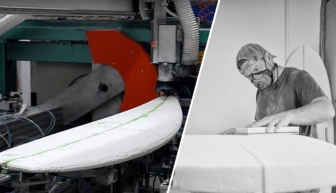
A topic that is becoming increasingly relevant within the surfboard industry is the argument between hand shaped surfboards and CNC machine cut surfboards. While both have their pros and cons, it seems shapers are passionate about either one method or the other.


Shaping surfboards originally started with a planer and big chunks of wood. During the 60s, with the innovation of foam, shapers gained a new material to make surfboards that are lighter and easier to sand into the desired shape. Hand shaping surfboards provides an opportunity for a shaper to put their knowledge, skills, and personal touch into a surfboard. It’s a special type of art: the shaper is the artist and the surfboard is the canvas. This type of skill is usually passed down from shaper to shaper through the generations. With hand shaping becoming less popular in this day in age, it is a skill that is becoming increasingly harder for the younger generation to learn. With recent technology, the surfboard industry has adapted the use of the CNC machine and thus replacing hand shaped boards. This allows shapers to design boards on the computer and cut majority of the foam with a machine. The CNC machine has enabled shapers to increase their production time as well as the amount of customers they can service.
Where does the controversy lie?
Those who are dedicated to only hand shaping surfboards see the CNC machine as technology working in a place it does not belong. The ‘hand touch’ is so important when creating a board. Adding an element of machinery takes away the special transfer of energy that happens between a shaper and the board. Since it can be harder to exactly replicate boards (which is often an argument made against hand shaped boards), it makes each board that much more special and valuable for the qualities it does possess. When you get a ‘magic’ board, you value it way more knowing that whatever gives this board its ‘special’ factor may not be able to be replicated again. While this can be seen as a negative, I see it as an opportunity to completely appreciate a hand shaped surfboard for everything it is and value each wave ridden on the board.
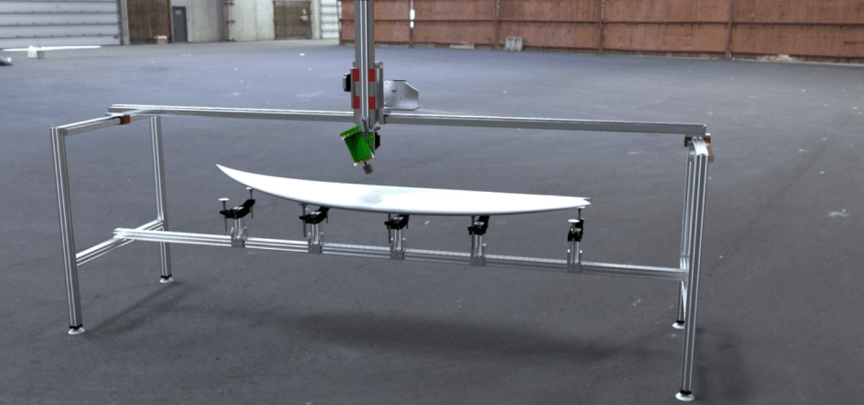
On the contrary, CNC machines allow for a quicker turn around in the production of boards. There may not be the human element in the board, but this quick turn around time is a really useful tool for professional shortboarders who are ordering 30-something boards at a time. In addition, it allows a board to easily be made anywhere in the world. With a push of a button, a surfboard file can be sent across the world and produced in the same day. This can work as an advantage to shapers who are trying to reach a global market as well as professional surfers who are always on the move and may need a particular type of shape to surf various types of waves.
All in all, as a surfer who has ridden the product of both hand shaped and machine cut boards, my heart and passion will always lie with hand-shaped boards. I understand the reasoning behind the use of a CNC machine, but I place a much higher value on the experience of getting dusted in foam and after hours of work and collaboration, producing a beautiful piece of functional art. The experience only gets better once you get to take the board into the water and test it in the surf! Watching a board turn from a chunk of foam to a wave riding tool is a valuable lesson that every surfer should experience.
 Vitamin Sea